Entering the second half of 2026, the heavy-duty truck industry is entering a new operational phase. After continuous growth in the second quarter, market activity cooled somewhat in July, but overall growth remained positive, exhibiting a new characteristic of "slower growth and structural optimization." How the market will evolve in the second half of the year has become a focus of industry attention.
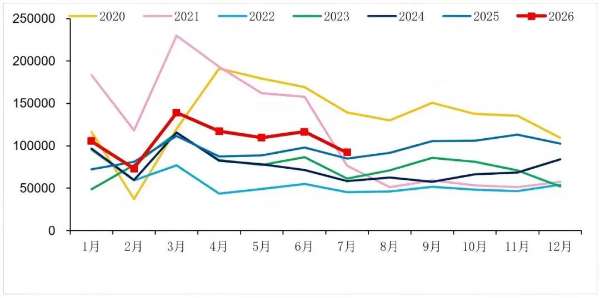
Monthly Sales Trend of my country's Heavy-Duty Truck Market, 2020-2026 (Unit: Vehicles)
◆ Five Consecutive Months of Growth, Market Enters a Phase of Adjustment
According to preliminary data from First Commercial Vehicle Network, in July 2026, my country's heavy-duty truck market sold approximately 92,000 units (wholesale caliber, including exports and new energy vehicles), representing a year-on-year increase of approximately 8.4%, and a month-on-month decrease of approximately 21% compared to June. From January to July this year, the cumulative sales volume of the heavy-duty truck industry was approximately 753,000 units, representing a year-on-year increase of approximately 21%, with the overall market maintaining a steady growth trend.
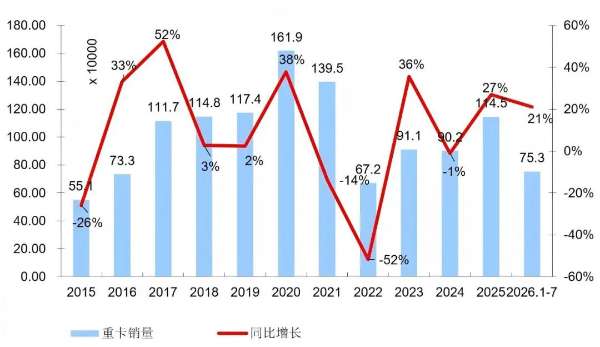
2015-2026 Annual Sales Trend of my country's Heavy-Duty Truck Industry (Unit: 10,000 Units)
From a market performance perspective, July saw continued year-on-year growth, primarily driven by strong overseas exports and rapid growth in new energy heavy-duty trucks. The month-on-month decline was largely due to factors such as the concentrated release of pent-up demand following the formal implementation of the AEBS regulations and the domestic market entering its traditional off-season, representing a normal market adjustment.
◆ Steady Export Growth Provides Strong Support for the Industry
Overseas markets remain a crucial driver of growth in the heavy-duty truck industry. Fueled by continued demand growth in Africa, Southeast Asia, Latin America, and Central Asia, my country's heavy-duty truck exports maintained strong performance, with July's export volume further increasing, providing significant support for the industry's continued growth.
Meanwhile, although the domestic market entered its off-season, replacement demand continued to be released, laying the foundation for the industry's long-term development. With the coordinated efforts of domestic and international markets, the heavy-duty truck industry continues to maintain strong resilience.
◆ New Energy Heavy-Duty Trucks Continue to Lead Industry Development
As the most dynamic segment of the current heavy-duty truck market, new energy heavy-duty trucks continue to maintain rapid growth momentum. Since the second quarter, the new energy heavy-duty truck market has continued to heat up, driven by multiple factors including the replacement of old vehicles meeting National IV and National V emission standards, the implementation of AEBS regulations, and operational cost advantages.
Entering July, with the completion of the regulatory transition and the traditional off-season, the market activity of new energy heavy-duty trucks cooled somewhat compared to May and June, but still maintained a year-on-year growth rate of approximately 68%, continuing to be a significant engine of growth for the heavy-duty truck industry.
Although the new energy heavy-duty truck market will continue to grow rapidly in the second half of this year (year-on-year), July and August are traditionally off-season months, and a certain decline is expected compared to May and June. August is likely to be the "bottom" for this segment in the second half of the year.
◆ Adjustment and Consolidation, Long-Term Positive Trend Remains Unchanged
Overall, the market cooling in July is more of a temporary adjustment than a change in the industry's development trend. Continued growth in the export market, sustained expansion of new energy vehicle sales, and steady release of vehicle replacement demand remain the core driving forces supporting the development of the heavy-duty truck industry.
Looking ahead to the second half of the year, with the continued implementation of policies to stabilize growth, the steady progress of key projects, and the continuous maturation of new energy technologies, the heavy truck industry is expected to accumulate new momentum during the adjustment period and continue to move towards green, intelligent, and high-quality development.