Summer Maintenance Tips for New Energy Concrete Mixer Trucks
Charge in the morning and evening, park in the shade,
Check the coolant level frequently.
Don't overinflate tires, check them often,
Clean and maintain the air conditioning in advance.
Drive gently and avoid direct sunlight,
Enjoy summer with your new energy vehicle!
Summer arrives, and the sun seems to be in "heating mode," the ground is scorching hot, the truck bed is burning hot, and even the air is sweltering. For new energy concrete mixer trucks, high temperatures, direct sunlight, heavy loads, and long hours of operation... every aspect tests the vehicle's condition.
With heavy traffic and hot weather, the worst thing isn't just being busy, but being "heated on top of heated." To ensure your new energy concrete mixer truck can reliably weather the hot summer, the following points must be taken seriously.
◆01 The Three-Electric System is Most Afraid of "Heat"
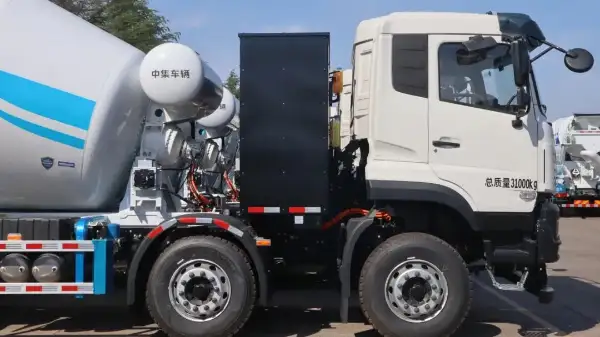
The core of a new energy concrete mixer truck is its three-electric system—battery, motor, and electronic control system. These three systems are most vulnerable to high temperatures, direct sunlight, and heavy loads that cause heat buildup.
Power Battery: Avoid High-Temperature Charging for a Longer Lifespan
The battery is the most valuable component of the entire vehicle and also the most vulnerable in summer. After being exposed to the scorching sun or working intensely, battery temperatures soar. Drivers need to develop several habits:
**Never charge while the battery is hot.** Avoid charging during the midday heat. After stopping work, let the battery sit for 15-20 minutes to cool down before charging.
**Few fast charges, many slow charges.** In summer, there's no need to store the battery at full charge; charging to 80%-90% is ideal.
**Park in the shade.** After work, park under a sunshade or in a well-ventilated area. Avoid leaving the battery exposed to direct sunlight all day to reduce heat buildup.
**Motor + Electronic Control:** Minimize heat buildup for optimal performance.
**Regularly check the coolant level, for leaks in the pipes, and for dust or blockages in the fan, radiator, and condenser.** If the vehicle reports a fault or abnormal power, don't try to force it. Immediately stop the engine, allow it to cool down, and inspect it. Continuing to drive a small problem will only lead to bigger issues!
◆02 Proper Maintenance of the Upper Structure for Doubled Efficiency
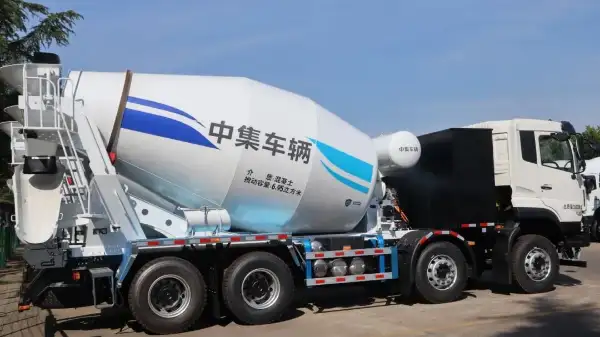
**After work, thoroughly clean the inside and outside of the mixing drum, removing any residual concrete from the blades and drum opening.** After the residue dries and hardens, it significantly increases the operating load on the tank, leading to increased power consumption, heat buildup, and accelerated wear.
High temperatures dilute lubricating and hydraulic oils, resulting in poorer lubrication and heat dissipation. Check oil levels and quality as needed, and replace with summer-specific oils promptly to avoid problems such as dry friction damage, unstable hydraulic pressure, and abnormal mixing speed.
◆03 Chassis and Tire Details: Ensuring Safety
Summer road temperatures easily exceed 60℃, and mixer trucks are constantly under heavy loads. Tires and the braking system are the first line of defense for safety.
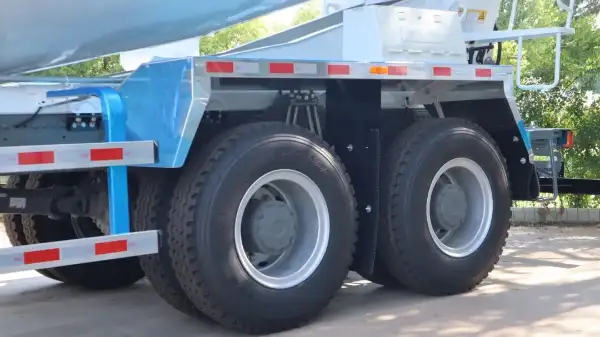
Tire pressure should be erroneously low. In winter, tire pressure can be slightly higher, but in summer, it is recommended to adjust to the lower limit of the standard value. Tire pressure will increase by 0.3-0.5 bar after driving; leaving a margin of safety is safer.
Before driving, check tire pressure, tread, and sidewalls for bulges or cracks. Replace any faulty tires immediately. Pay attention to the condition of the braking system on long downhill slopes and sections with frequent braking to prevent high temperatures from reducing braking performance.
◆ 04 Good Habits for a Healthy Vehicle: Save Money and Reduce Trouble
The condition of a vehicle depends 30% on the vehicle itself and 70% on the driver. This is especially true for new energy concrete mixer trucks, where driving habits significantly impact energy consumption, range, and overall vehicle lifespan.
In summer, avoid sudden acceleration and braking to minimize unnecessary prolonged high-load operation. Utilize regenerative braking when going downhill or slowing down. Before turning off the engine, turn off the AC (compressor) and let the air circulate for two minutes to dry the evaporator.
Summer construction site conditions are complex and prone to unexpected situations. Being prepared for emergencies in advance can prevent losses in critical moments. Keep a dry powder fire extinguisher and emergency power-off tools readily available in the vehicle, and ensure the driver is familiar with emergency procedures. Pay close attention to instrument readings during operation, especially the battery, motor, and coolant temperatures.
If any abnormalities occur, such as a sudden increase in temperature, malfunction alarms, unusual odors, or smoke, immediately stop the vehicle, turn off the engine, move away from the vehicle, and ventilate to cool it down. Do not attempt to disassemble the vehicle yourself; contact a professional for repair immediately.
CIMC Vehicles' DTB/Concrete Mixer Truck Business Group has a service network covering 31 provinces, municipalities, and autonomous regions across China and exports to more than 50 countries and regions. It has over 200 authorized after-sales service stations, providing 24/7 service to achieve "nearby service and rapid response".