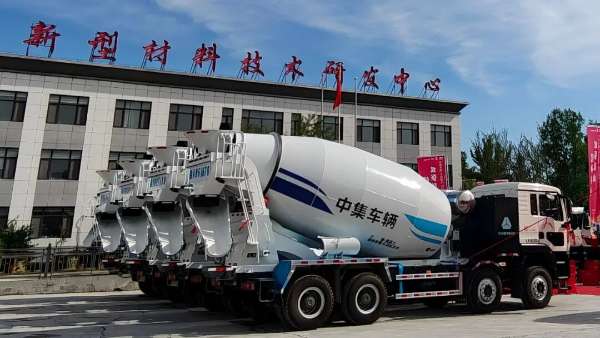
Recently, a press conference held by the State Council Information Office on the "15th Five-Year Plan" for transportation released a significant signal: in 2026, the state will allocate 22 billion yuan in ultra-long-term special treasury bonds specifically for the scrapping and replacement of old commercial freight vehicles, with a focus on new energy heavy-duty trucks. Simultaneously, more than 3,000 electric heavy-duty truck charging and battery swapping stations will be built.
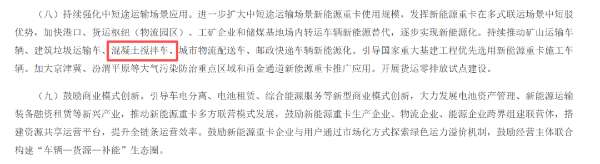
Previously, the "Implementation Plan for Promoting the Large-Scale Application of New Energy Heavy-Duty Trucks" (Jiaoguihua Fa [2026] No. 52), jointly issued by eleven departments including the Ministry of Transport and the National Development and Reform Commission, explicitly mentioned "continuously promoting the electrification of mining transport vehicles, construction waste transport vehicles, concrete mixer trucks, urban logistics delivery vehicles, and postal express vehicles," and proposed "guiding major national infrastructure projects to prioritize the use of new energy heavy-duty truck construction vehicles." With this dual national-level policy of "funding + roadmap," the large-scale application of new energy heavy-duty trucks is entering an accelerated phase.
Implementation Plan for Promoting the Large-Scale Application of New Energy Heavy-Duty Trucks (Ministry of Transport Planning Document No. 52 [2026])
National Stance: 22 Billion Yuan in National Bonds + 3,000 Charging and Battery Swapping Stations – Focus Clearly Targeting New Energy Heavy-Duty Trucks
At the press conference on July 21, Cai Tuanjie, Director of the Safety Supervision Department and Director of the Transport Services Department of the Ministry of Transport, clarified three points:
First, the scrapping and replacement of old commercial freight vehicles will continue in 2026, with 22 billion yuan in ultra-long-term special national bonds allocated, primarily supporting the replacement with new energy heavy-duty trucks. This means that the national-level funding pool is in place; it's not just a statement of "encouragement," but a real financial guarantee.
Second, more than 3,000 electric heavy-duty truck charging and battery swapping stations will be built, promoting the "connection of points into lines and networks" of energy replenishment facilities. Energy replenishment anxiety has always been the biggest obstacle to the electrification of heavy-duty trucks, and the plan for 3,000 stations directly addresses this pain point.
Third, promote full-scenario application. While expanding the use of new energy heavy-duty trucks in short- and medium-distance transportation scenarios, accelerate the electrification of closed scenarios such as in-yard transfers at major freight nodes and port and mining areas.
Since July, local detailed rules have been intensively followed up, with more and more policies specifically targeting concrete mixer trucks.
Hangzhou: Concrete mixer trucks can receive up to 190,000 yuan in subsidies. On July 6, a briefing on supporting policies for the elimination and replacement of old diesel trucks in Hangzhou provided a detailed interpretation of the "Hangzhou Three-Year Action Plan for the Elimination and Replacement of Old Diesel Trucks to Promote Pollution Reduction and Carbon Reduction Reform (2026-2028)" and the "Hangzhou Management Measures for Subsidies for High-Power Charging Facilities for New Energy Trucks (2026-2028)". The three-year action plan clearly lists "concrete mixer trucks and construction waste transport trucks" as the sub-sectors to be prioritized for breakthroughs, while subsidies for high-power charging facilities are specifically targeted at charging facilities for medium and heavy-duty trucks such as "new energy concrete mixer trucks and construction waste transport trucks". Taking a heavy-duty National V emission standard concrete mixer truck as an example, if it is scrapped and replaced with a pure electric vehicle in 2026, it can receive a scrapping subsidy of 45,000 yuan + a replacement subsidy of 95,000 yuan + a first-year bonus of 50,000 yuan, totaling a maximum of 190,000 yuan. The policy will be implemented from August 30, 2026, and will be valid until the end of 2028.
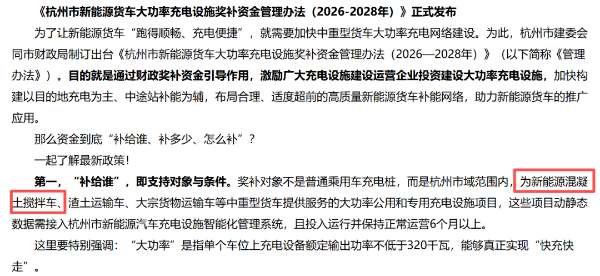
Source: Hangzhou Municipal Government's Briefing on Supporting Policies for the Scrapping and Replacement of Old Diesel Trucks
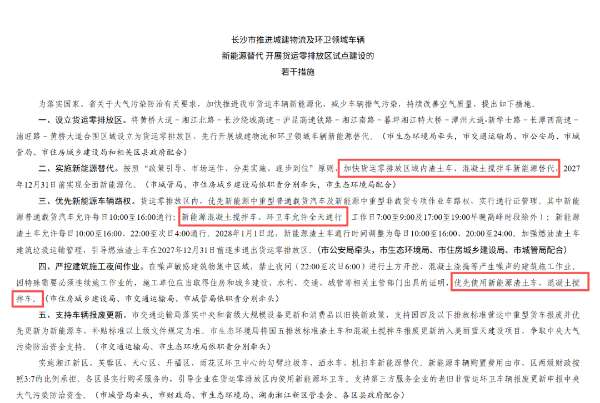
Changsha: On August 7, a pilot program for zero-emission freight zones was launched, requiring "government-invested projects to prioritize the use of new energy concrete mixer trucks." This will take effect on September 5, changing the requirement for new energy mixer trucks from "optional" to "required."
Source: Several Measures of Changsha City to Promote the Replacement of New Energy Vehicles in Urban Construction, Logistics and Sanitation Sectors and to Carry Out Pilot Construction of Zero-Emission Zones for Freight Transport
In addition, Anhui and Guizhou released subsidy plans on July 15th, and Heilongjiang held a policy press conference on July 31st; Henan is implementing a gradual reduction in subsidies, with a subsidy of 15% of the new vehicle invoice in 2026, up to a maximum of 80,000 yuan; Guangdong's subsidy for replacement is up to 140,000 yuan, and Zhengzhou will include concrete mixer trucks in the pure electric heavy truck purchase subsidy in August, with a payment of 5% of the invoice. The national central benchmark subsidy is up to 140,000 yuan, and the upper limit is even higher in some areas after local subsidies are combined.
Supporting Benefits: Green Procurement, Road Rights, and Carbon Benefits
Green Procurement Threshold Increased: According to industry survey data, in 2026, the coverage rate of the "Green Construction Equipment Procurement Catalog" in national local government special bond projects has reached 92%, and new energy concrete mixer trucks are changing from "optional" to "mandatory". Road Rights and Traffic Incentives: Many places provide traffic convenience for new energy freight trucks, and in some areas, new energy vehicles can enjoy highway toll discounts. Against the backdrop of increasingly stringent urban traffic restrictions, the advantage of right-of-way itself represents a tangible operational value. Carbon quota revenue: With the implementation of detailed rules for carbon quota trading, industry analysts point out that each electric mixer truck can earn additional revenue annually through carbon trading. While specific revenue varies depending on the region and trading price, this is an incremental income that gasoline-powered vehicles simply do not have. Emission standards are forcing change: The deadline for the "oil-to-electric" conversion of construction machinery in the Beijing-Tianjin-Hebei region and the Yangtze River Delta has been clearly brought forward to the third quarter of 2026. The window for phasing out National III and National IV emission standard vehicles is narrowing; the longer it is delayed, the lower the residual value of old vehicles and the higher the replacement costs.
The flurry of policy announcements is not a coincidence, but a systematic advancement of the green transformation of transportation under the national "dual-carbon" goals. The policy winds have blown; the remaining question is when to set sail.