Spring brings warmth and renewal to the industry. After a hibernation during the Spring Festival off-season in February, the heavy-duty truck market has seen a timely spring! Has the heavy-duty truck market experienced a strong recovery in March?
Peak Season Returns: March Sales Up 17% Year-on-Year
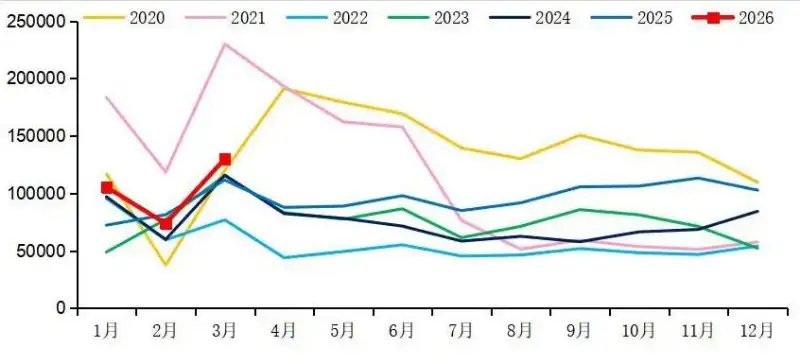
According to preliminary statistics from First Commercial Vehicle Network, in March 2026, wholesale sales of heavy-duty trucks in my country (including exports and new energy vehicles) exceeded 130,000 units, a significant increase of approximately 80% compared to February and approximately 17% compared to the same period last year. This achievement not only represents the highest monthly sales figure this year but also sets a new historical high for March sales in the past five years.
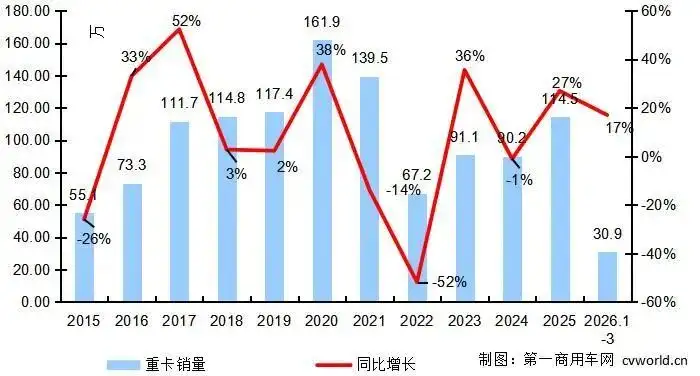
Cumulatively, total heavy-duty truck sales in the first quarter of this year reached approximately 309,000 units, a year-on-year increase of 17%, laying a solid foundation for the start of the year.
[Chart showing annual sales trend of my country's heavy-duty truck industry from 2015 to 2026 (unit: 10,000 units)]
The strong rise of the heavy-duty truck market in March is not accidental but the result of three core factors: the return of the traditional peak season, strong sales in niche markets, and increased overseas demand.
The timing of the Spring Festival was a significant factor driving the concentrated release of demand. This year's Spring Festival was nearly 20 days later than last year, extending the off-season and forcing the suppression of substantial car purchase demand in February. With the Lantern Festival ending in early March, the national freight industry fully resumed operations, and truck owners' urgency to return to work and replace their vehicles far exceeded that of the same period last year. This pent-up demand was released in March, becoming the core driver of market growth.
March, as the final month of the first quarter, saw major automakers ramping up their production and sales efforts. Online product launches, offline regional promotions, and terminal discount activities were all launched, with brand and terminal marketing working in tandem, effectively boosting both production orders and wholesale sales.
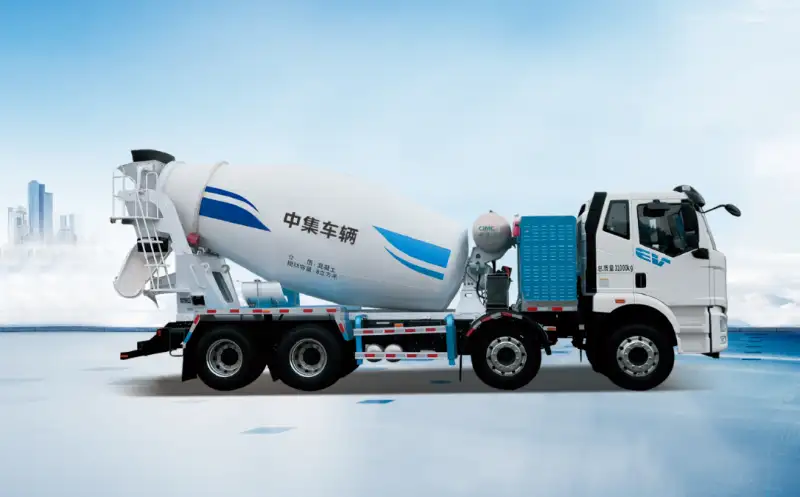
In early March, the Middle East geopolitical crisis caused a short-term surge in both domestic oil and gas prices, temporarily impacting consumer car purchase decisions. However, gas prices subsequently fell rapidly, while oil prices rose again, widening the price gap between oil and gas once more. Currently, the oil-gas price difference remains stable at around 3 yuan, highlighting the operational economic advantages of LNG trucks and driving a profound adjustment in the sales structure of the heavy-duty truck market. Natural gas heavy-duty trucks have become the new favorite in the market, while demand for diesel heavy-duty trucks remains relatively weak.
Driven by strong demand from logistics infrastructure construction and the mining industry in Asia, Africa, and Latin America, my country's heavy-duty truck exports increased by nearly 30% year-on-year in March 2026.
Hot end-user demand drives a surge in electric heavy-duty truck sales
New Energy Heavy-Duty Trucks
Behind the booming wholesale sales is the continued strength of the domestic end-user market. In March 2026, domestic heavy-duty truck end-user sales increased by over 10% year-on-year and surged by approximately 1.8 times compared to February, with robust production and sales becoming the main theme of the market. Among them, the new energy heavy-duty truck segment performed particularly well, achieving rapid growth and becoming the core force driving end-user demand.
High-speed growth was achieved under the dual stimulus of peak season demand and rising oil prices. In March 2026, sales of new energy heavy-duty trucks increased by over 1.6 times month-on-month and over 30% year-on-year, with market penetration remaining stable at 25%-26%.
Although the trade-in subsidy policy for National IV and National III emission standard commercial trucks has not yet been officially implemented, and many potential users are still in a wait-and-see state, the demand for new energy heavy-duty trucks is expected to be further activated as policy benefits are subsequently released. Sales are expected to show a month-on-month upward trend in the first half of the year, becoming a new growth engine for the heavy-duty truck market.
Policy benefits are building momentum; the market in the second quarter is worth looking forward to
The strong performance of the heavy-duty truck market in March 2026 was actually a natural release of industry demand, without the real boost from policy benefits. This untapped consumer potential is a key driver of growth in the heavy-duty truck market in the second quarter.
With the continued rise in the traditional peak sales season in the second quarter, coupled with the gradual implementation of the trade-in policy, pent-up replacement demand will be further released, injecting new growth momentum into the market. With multiple positive factors converging, the heavy truck market in the second quarter is bound to continue the positive trend of March and usher in a new wave of growth.